
AI is an all-purpose tool. Make training the price of admission.
Stop asking staff to prove the value of a tool they have not been allowed to try. Give everyone a practical training path—and access they are eligible to use.
When we rolled out email, we made people fill out forms and get approval. Then we gave them access one by one.
Eventually, everyone got it.
We reached the same destination, but took the slow, painful route through the paperwork. Apparently the first requirement for better communication was getting permission to communicate.
Now I hear the same question about AI: “Who really needs it?”
AI is an all-purpose tool. Writing, explaining, comparing, organizing, preparing—those jobs turn up across departments and job titles. Everyone should have a chance to discover where it helps with their work.
Who gets access? Who can wait? Who has submitted a business case? We’re asking people to explain the value of a tool they haven’t had a reasonable chance to try.
Please explain the thing you have not been allowed to use. Include a return on investment. The committee meets next month.
Often, the real hesitation is the bill. Leadership doesn’t want to buy licenses that sit unused. Fair enough. A subscription nobody knows how to use is a very efficient way to waste money.
So make training the condition for getting access. Give everyone a path through it.
What happens after people get some training?
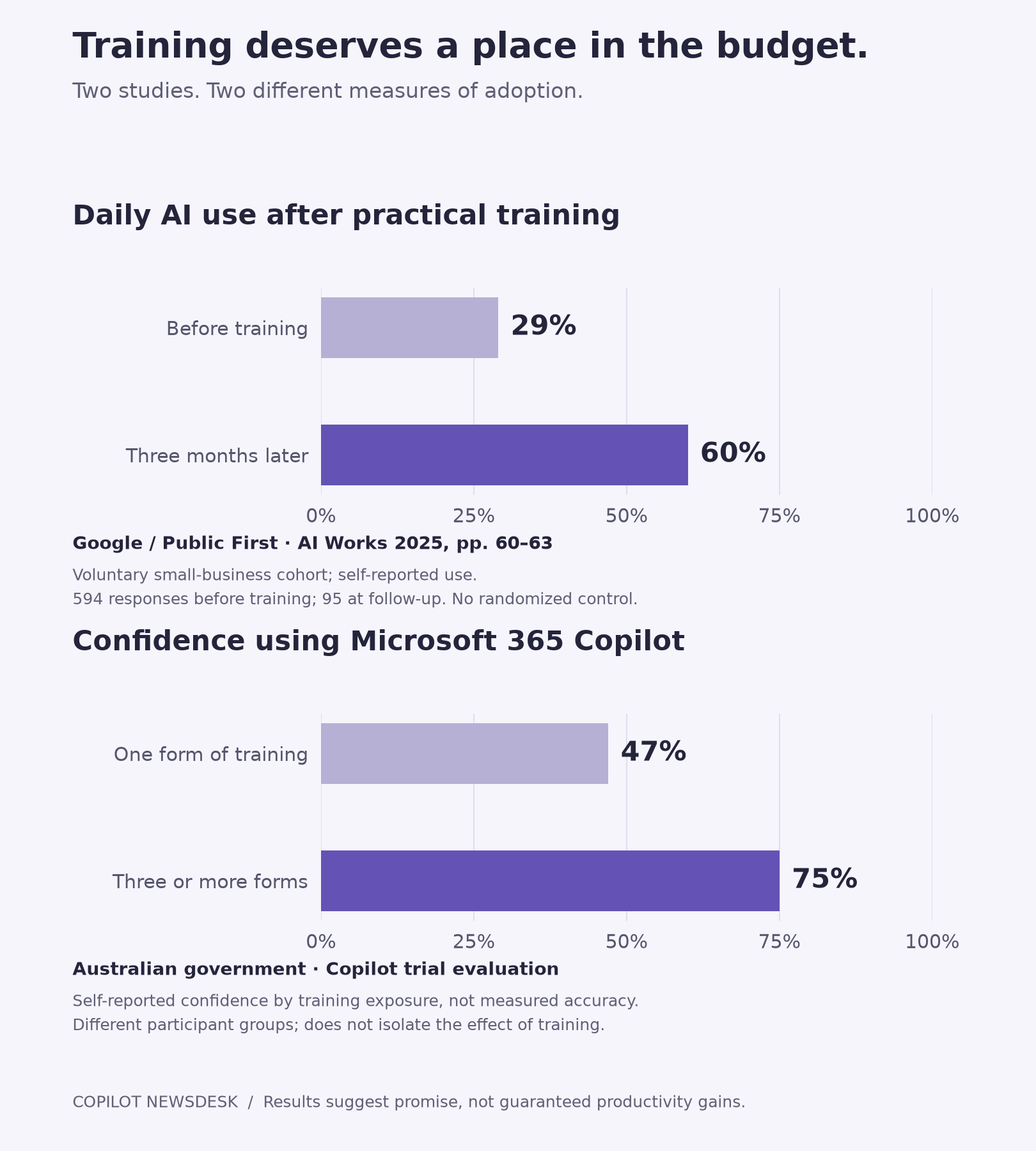
Google’s 2025 AI Works report, with research by Public First, followed workers after practical AI training. Among small-business survey respondents, daily AI use rose from 29% before training to 60% three months later. That is a useful result: people were still using it after the class was over. AI Works report, pages 60–63
Keep the fine print attached. This was a Google-backed program with volunteers and self-reported results, not a randomized test. The before-training survey had 594 responses; the three-month follow-up had 95. Those figures suggest promise, not a guarantee that a class will double your organization’s usage.
There is Copilot-specific evidence too. In the Australian government’s trial evaluation, 75% of participants who received three or more forms of training felt confident using Copilot, compared with 47% of those who received one form. That measures confidence, not accuracy or productivity, and it does not prove training alone caused the difference. Australian government evaluation
My takeaway: budget for helping people learn, then check whether they actually use what they learned. Buying the license and emailing everyone a link is a purchasing process. It is a fairly optimistic training program.
Train everyone who wants in
Offer practical training across the organization, with time to attend during the workday. Provide supervised access during the session so employees can actually practice. Teach them what information they can use, how to check an answer, and how to apply the tool to a real task.
Complete the training, get the approved baseline access. Make the requirement clear and the training easy to reach. Don’t replace the email approval form with a six-month waiting list for a class.
Then give people somewhere to ask questions and share discoveries. Training should open the door, not become another way to keep it closed.
The employee who spots a useful application might not have the most impressive title. They might simply be the person who does the awkward, repetitive task every afternoon.
Leadership cannot predict every one of those opportunities from a conference room. Broad participation gives those ideas a chance to surface.
With AI, we risk spending so much time deciding who deserves to try it that we delay finding out where it helps. Give staff an approved starting point and help them learn.
Broad access needs a clear plan
Give everyone a baseline they are eligible to use. Keep permissions appropriate, explain what information belongs in the tool, and teach people how to check its output. Make support part of the rollout.
You can do that without buying every add-on for everybody. Start with the access your organization can provide, keep data permissions in place, and use what employees learn to decide where additional paid capabilities are worth it.
Microsoft documents a Copilot Chat baseline for eligible Microsoft 365 subscriptions. Confirm your actual entitlement and configuration before promising a particular feature. Microsoft’s overview
Ask employees what they tried, what helped, and what failed. Make those discoveries easy to share. That gives the next investment a much better foundation than a list of job titles.
If the concern is paying for a tool people won’t use, teach them how to use it.
Make training the price of admission. Then let people in.